1 WHY OLIVE
Why do we need OLIVE?
Application Scenarios
Let’s start by looking at some application scenarios from different perspectives.
Customer Driven
Customers expect us to adopt new technologies quickly.
They want support for the latest protocols and integrations, for example supporting the Model Context Protocol so that their AI solution can use our services.
The key point is not any single technology, but our ability to react fast and make BOC services part of these emerging ecosystems.
This flexibility will keep us relevant and valuable for our customers.
Market Observation
Market observations show a rising demand for data integration in the field of regulations.
In the EU, new and overlapping rules are growing rapidly.
To deal with this, businesses need ways to process regulation documents automatically and integrate new data.
They must be able to understand the text, extract key concepts such as risks, measures, or data categories, and compare them across different regulations.
This helps identify overlaps, gaps, and conflicts.
Companies that can do this will save time, cut compliance costs, and stay ahead of regulatory change.
BOC Software Architecture
Finally, BOC products are moving from single large solutions to ecosystems of smaller services.
This brings new opportunities, but also challenges.
If we are not careful, we risk ending up with a ‘distributed monolith’: many services that are too dependent on each other.
To prevent this, we need to design clear declarative data flows and keep services independent.
At the backend as well as on the frontend.
This makes them easier to reuse in different situations and helps us stay flexible for the future.
Conclusions
With these application scenarios in mind, it’s clear that we need a way to connect things – quickly enough to respond to new technological changes, and reliably enough to serve customers with confidence.
We need a connectivity framework of conceptual ideas and a technology platform to quickly develop reliable, and quality-validated solutions.
In other words, we need both a connectivity framework of conceptual ideas and a technology platform that enables the rapid development of reliable, quality-assured solutions.
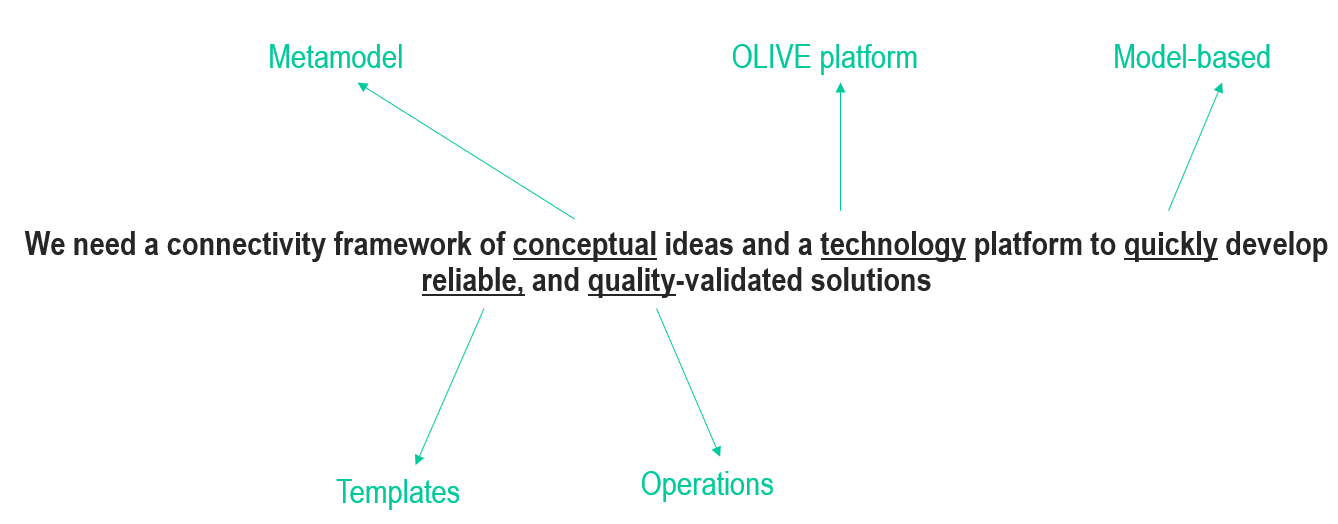
Let’s have a closer look at the details of this sentence:
- A framework of conceptual ideas: This means that we need some metamodel-based approach. It’s not enough to use concrete and pre-determined solutions; we need the flexibility that comes from using a Metamodel, which allows us to connect ideas independent from their implementation.
- A technology platform: We need a platform that specializes in the technologies needed in a connectivity context.
- Quickly develop: We want a model-based framework that allows us to develop through configuration instead of hard-coding solutions.
- Reliable solutions: We need a way of ensuring the solutions created are secure, effective, and follow pre-defined patterns.
- Quality-validated solutions: The developed solutions should be automatically quality approved and operate in a safe environment.
To recap we address:
- Concepts with our Metamodel approach.
- The Technology platform is our OLIVE platform.
- Quickly develop is enabled by our model-based approach.
- Reliable we can provide by our guided / template approach.
- Quality we achieve by having the OLIVE platform deployed in operation.